Why Knowing Your Water Heater's Age Could Save You Thousands: A Pro's Guide to Reading Serial Numbers
The Hidden Clock Ticking in Your Basement
Picture this: It's a chilly winter morning, and you're rushing to get the kids ready for school. You turn on the shower, only to be hit with a blast of ice-cold water. Your water heater has given up the ghost—right when you need it most. As a contractor with over 15 years in the plumbing trenches, I've seen this scenario play out too many times. The good news? It doesn't have to be this way. By simply knowing your water heater's age, you can stay one step ahead and potentially save thousands in emergency repairs and water damage.
Water heaters are the unsung heroes of our homes, quietly providing hot water for showers, dishes, and laundry without much fanfare. But like all appliances, they have a finite lifespan. Most conventional tank-style water heaters last 8 to 12 years, while tankless models can go up to 20 years with proper maintenance. Ignoring their age is like driving without checking your oil—eventually, things break down, and the bill skyrockets. In this post, we'll dive into why age matters, how to crack the code on your unit's serial number, and the smart reasons to replace it before disaster strikes.
Why Your Water Heater's Age Is a Big Deal
Age isn't just a number for your water heater; it's a predictor of reliability and efficiency. As these units age, they become less efficient, using more energy to heat the same amount of water. According to the U.S. Department of Energy, an old water heater can waste up to 20% more energy than a new, efficient model. That translates to higher utility bills—potentially hundreds of dollars a year.
But the real kicker comes when failure hits. An unexpected breakdown often leads to emergency service calls, which can cost $200 to $500 just for the visit, plus parts and labor. If the tank ruptures, you're looking at water damage repairs that could run into the thousands—think ruined floors, mold growth, and structural issues. I've pulled rusted-out tanks from basements where the damage alone exceeded the cost of a new unit.
Proactive awareness changes the game. Knowing your heater's age lets you plan for replacement during a slow season when contractor rates are lower and you can shop around. It also minimizes disruption—no cold showers during peak family time. In short, it's about control: turning a potential crisis into a calculated upgrade.
Decoding the Serial Number: Your Water Heater's Birth Certificate
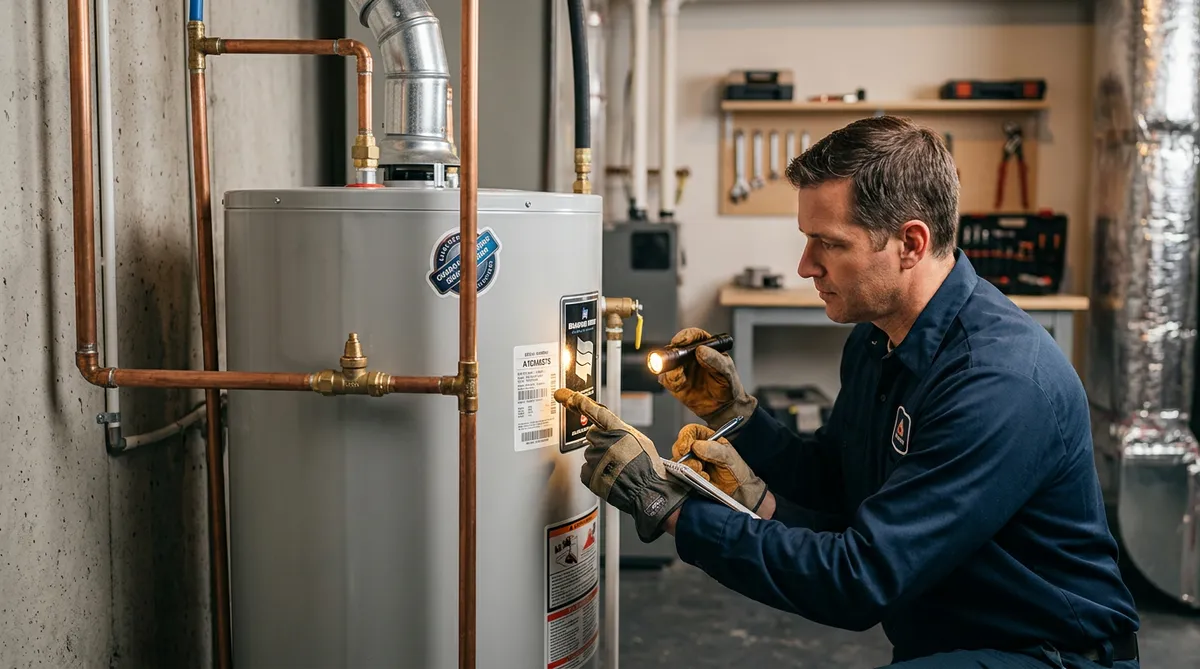
The easiest way to determine your water heater's age is by checking its serial number. This unique identifier is usually stamped on a label or plate on the unit itself—often on the side, top, or back. You'll need a flashlight and maybe a step stool, but it's a quick task that any homeowner can handle.
Serial numbers vary by manufacturer, but they typically encode the production date in the first few digits. Here's a breakdown of how to read the most common brands:
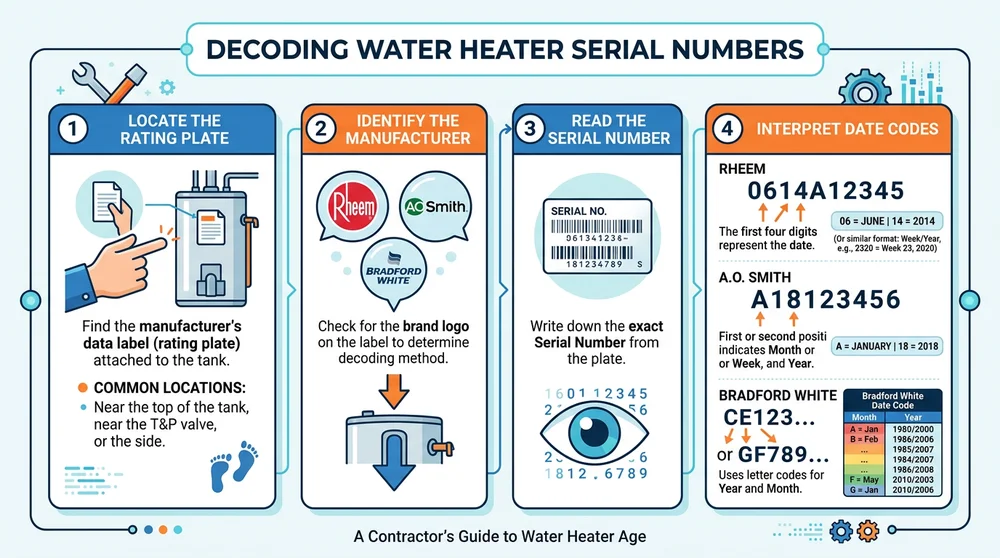
Rheem and Ruud
Rheem, a popular choice for residential units, uses a four-digit code at the start of the serial number representing the year and month. For example:
- Serial number starting with "0423" means it was made in April 2023.
- The first two digits are the month (01-12), followed by the last two for the year (e.g., 23 for 2023).
If your Rheem is from the early 2000s, look for codes like "1205" (December 2005). Pro tip: Rheem tanks often have the label near the gas valve or electrical junction box.
A.O. Smith
A.O. Smith, another industry giant, formats their serial numbers with the first three or four characters indicating the year and week of manufacture. It might look like "1234HXXXXX," where "1234" breaks down to year (12 for 2012) and week (34th week of the year).
- For older models, it could be the first four digits: year followed by month (e.g., "20065" for May 2006).
Check the upper part of the tank or the rating plate for this info. A.O. Smith units are straightforward once you spot the pattern.
Bradford White
Bradford White serial numbers start with a letter for the month (A=January, B=February, etc.) followed by the year. So, "C23" means March 2023.
- The full serial might be "C23-XXXXX," with the date code up front.
These are often found on the jacket or near the flue pipe. Bradford White is known for durability, but even they have limits.
Other Brands: General Tips
For brands like State, Reliance, or GE, the format is similar—often the first four digits are MMYY (month and year). If you're stumped, snap a photo of the serial number and look it up on the manufacturer's website or call their customer service. Apps like "Water Heater Age" can also help decode it quickly.
Once you've got the date, jot it down. If your unit is pushing 10 years or more, it's time to start thinking about the next steps. Remember, hard water areas or poor maintenance can shave years off that lifespan, so factor in your local conditions.
Signs It's Time for Replacement—Beyond Just the Age
Age is a key indicator, but your water heater might be waving red flags even if it's "young." As pros, we look for these telltale signs during inspections:
- Discolored or Smelly Water: Rusty water points to internal corrosion. Sediment buildup can cause a sulfur-like odor, especially in gas models.
- Inconsistent Hot Water: If it takes forever to get hot or runs out quickly, the tank might be failing to recover efficiently.
- Leaking or Noisy Operation: Drips around the base or banging sounds (like popcorn popping) signal sediment or a weakening tank.
- Rising Energy Bills: A sudden spike without increased usage? Your heater's working overtime.
If you spot any of these, don't wait. A professional inspection costs about $100 and can prevent a $1,500+ replacement job turning into a $5,000 disaster. We recommend annual flushes to extend life, but nothing beats timely replacement.
The Cost-Saving Power of Proactive Replacement
Let's talk numbers. The average cost for a new 50-gallon gas water heater installation is $800 to $1,500, including the unit and labor. Electric models run $500 to $1,200. Compare that to an emergency call: diagnostics ($150+), plus if it's beyond repair, you're paying premium rates for rushed installation—often 20-50% more.
Proactive replacement shines in other ways too. Newer models are Energy Star-rated, cutting your water heating costs (which account for 18% of home energy use) by up to 50%. Features like Wi-Fi monitoring let you track performance remotely, catching issues early.
From a contractor's view, scheduling during off-peak times means better deals on materials and our availability. I've helped homeowners swap out 12-year-old units for high-efficiency ones, saving them $300 annually on bills alone. The ROI is quick—often within 3-5 years.
Choosing the Right Replacement: Pro Tips for Homeowners
When it's time to upgrade, don't just grab the cheapest option. Consider these factors:
Fuel Type: Stick with gas if you have it; switching to electric might require wiring upgrades. Tankless systems save space and energy but cost more upfront ($2,000-$4,000 installed).
Capacity: For a family of four, 40-50 gallons is standard. Undersized units cycle too often, wearing them out faster.
Efficiency and Features: Look for models with better insulation and low-NOx burners for gas. Hybrid heat pump water heaters are game-changers in mild climates, slashing electric bills by 60%.
Warranty and Brand: Aim for 6-12 year warranties. Trusted brands like those mentioned earlier offer reliable support.
Get multiple quotes from licensed pros—check reviews on sites like ContractorLink.pro. Insist on permits and code compliance to avoid future headaches. A properly installed unit should last the full warranty period with basic care.
Wrapping It Up: Take Control Today
Your water heater might be out of sight, but it's not out of mind for savvy homeowners. By decoding that serial number and heeding the signs of age, you empower yourself to avoid the chaos and expense of failure. It's a small effort with massive rewards—lower bills, peace of mind, and a home that runs smoothly.
Next time you're in the basement or utility closet, give your water heater a once-over. You might just uncover the info that saves you thousands down the line. After all, in home improvement, knowledge truly is power.
(Word count: 1,248)