How Your Home's Electrical Panel Works (In Plain English)
Your home's electrical system is like the heart of your house, pumping power to lights, appliances, and outlets. But that metal box tucked away in your basement, garage, or utility room—the electrical panel—often feels like a black box full of mystery. As contractors who've wired countless homes, we've seen homeowners stare at it in confusion, unsure if a tripped breaker means disaster or just a minor hiccup. Don't worry; we're here to demystify it all without the jargon. In this post, we'll explain how your electrical panel works, what breakers and circuits do, and how to gauge your home's capacity. By the end, you'll feel more confident flipping switches and spotting potential issues.
What Is an Electrical Panel, Anyway?
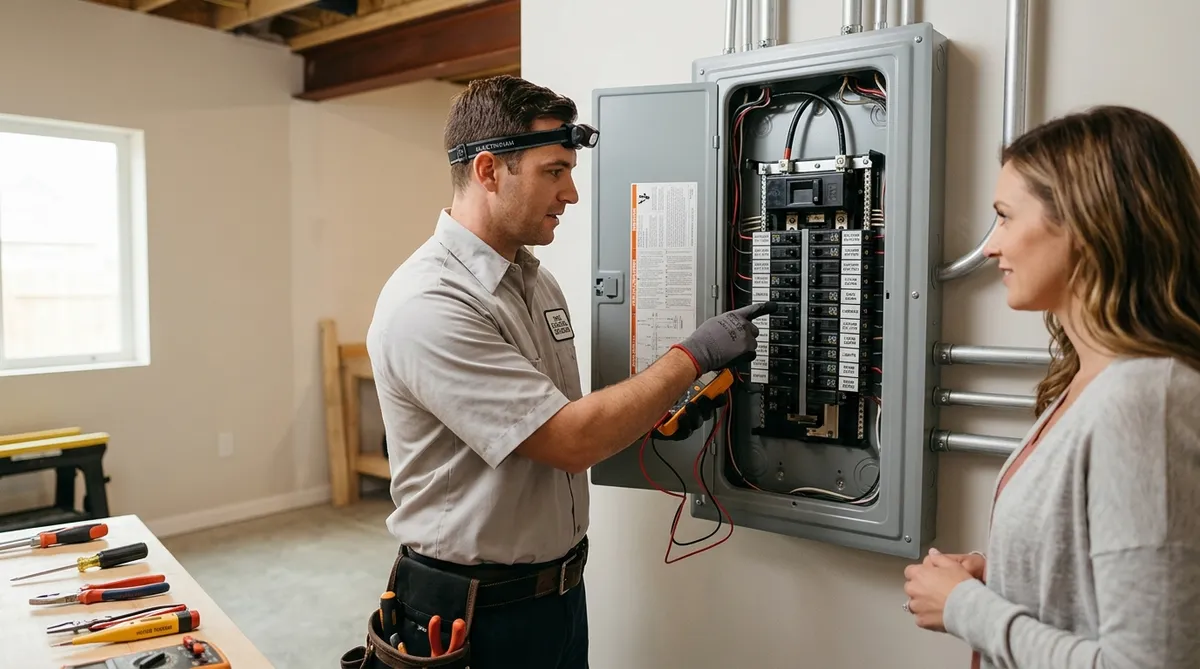
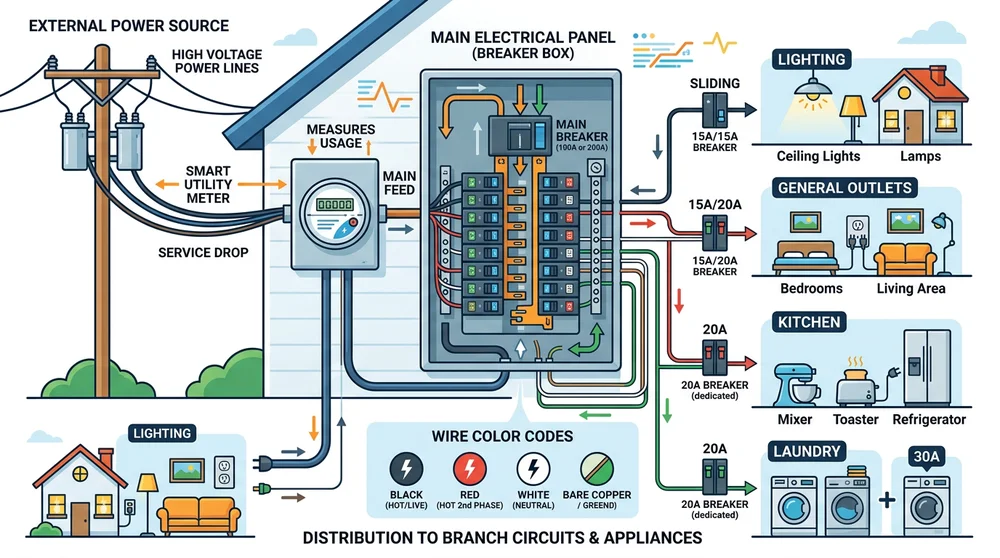
Think of your electrical panel as the command center for all the electricity flowing into your home. It's where power from the utility company enters your house and gets distributed to different areas. Most modern homes have a main service panel, often called the breaker box, which houses circuit breakers that control the flow of electricity.
Electricity comes from the power lines outside your home, through a meter that tracks your usage, and into the panel. Inside, you'll see rows of switches—these are the breakers. Older homes might have fuses instead, but we'll focus on breakers since they're standard in newer setups. The panel is usually labeled with a main breaker at the top or side, which can shut off power to the entire house in an emergency.
As pros, we always advise locating your panel early. It's often in a dry, accessible spot, but avoid storing stuff in front of it—clear space is key for safety. If you're buying an older home, check if the panel is outdated; panels from before the 1990s might not handle today's gadget-heavy loads.
Breakers: Your Home's Safety Guardians
Breakers are the heroes of your electrical panel. Each one acts like a smart gatekeeper, monitoring the electricity flowing through its assigned circuit. If too much current tries to pass—like when you overload a circuit with too many appliances—the breaker 'trips,' cutting off the power to prevent fires or damage.
There are two main types: standard breakers for everyday circuits and ground-fault circuit interrupter (GFCI) breakers for areas like bathrooms or kitchens, which detect leaks in the current and shut off fast to avoid shocks. Arc-fault circuit interrupters (AFCIs) are another type, designed to spot dangerous sparking that could start a fire.
When a breaker trips, you'll hear a click or see the switch flip to the middle position (not fully off). To reset, flip it all the way off, then back on. But don't just keep resetting—if it trips again, there's an underlying issue like a faulty appliance or wiring problem. We've fixed many homes where repeated resets led to bigger headaches.
Pro tip: Label your breakers clearly. It sounds basic, but most panels we encounter have vague scribbles or nothing at all. Turn off breakers one by one and check which lights or outlets go dark. This map will save you time during outages.
Circuits: The Pathways of Power
Circuits are the roads that carry electricity from the panel to your outlets, lights, and appliances. Each circuit is a loop: hot wire carries power out, neutral brings it back, and ground provides a safe path for stray current.
Your home typically has 20 to 40 circuits, depending on size and age. Lighting circuits might handle 15 amps, while kitchen ones could be 20 or 30 amps for heavier loads like ovens. Wires are color-coded—black or red for hot, white for neutral, green or bare for ground—and sized by gauge (thicker for more power).
Imagine your panel as a traffic hub: each breaker directs cars (electrons) along specific routes. Overloading a circuit is like too many cars jamming a highway—the breaker steps in to clear it. Common circuits include:
- General outlets: For lamps, TVs, and chargers (15 amps).
- Kitchen and laundry: Dedicated for high-draw items like refrigerators or dryers (20-30 amps).
- Lighting: Separate to avoid dimming when you plug in a vacuum.
If you're renovating, adding a circuit might be necessary. We've seen folks try daisy-chaining extensions, which is a fire hazard. Instead, plan for dedicated circuits for big appliances—your panel's layout matters.
Understanding Your Home's Electrical Capacity
Capacity is all about how much power your system can handle without strain. It's measured in amps (the flow rate) and volts (the pressure). Most U.S. homes run on 120/240-volt systems, with a main service rating of 100, 200, or 400 amps.
To figure yours, check the main breaker label—it's usually 100 or 200 amps for average homes. But capacity isn't just the total; it's how it's divided. Calculate your load by adding up appliance ratings (found on labels, in watts—divide by 120 for amps). For example, a 1,200-watt microwave draws 10 amps.
Rule of thumb: Don't exceed 80% of a circuit's capacity for safety. A 15-amp circuit maxes at 12 amps continuously. Whole-home load? Aim under 80% of your service rating. Tools like online calculators can help, but for accuracy, we recommend a load calculation by a pro.
Upgrading capacity? If your panel's maxed out—frequent trips, flickering lights—consider a service upgrade. Modern homes with EVs, home offices, and smart devices often need 200+ amps. Costs vary, but it's cheaper than a fire claim.
Common Issues and How to Spot Them
Even simple systems have quirks. Tripped breakers are common from overloads, but watch for:
Flickering lights: Loose connections or undersized wiring.
Warm outlets or panels: Sign of overload—unplug and call us.
Burning smells: Emergency—shut off main and evacuate.
Older panels like Federal Pacific or Zinsco have known defects; if yours matches, upgrade ASAP. We inspect these during consultations and have replaced many to prevent failures.
Maintenance tips:
Test GFCI outlets monthly—press 'test' then 'reset.'
Avoid extension cord marathons; they're temporary.
Schedule inspections every 3-5 years, especially post-storm.
Never DIY major wiring—codes are strict for a reason.
Understanding these keeps your home safe and efficient.
When to Bring in the Pros
While basic resets are DIY-friendly, anything beyond—like buzzing panels, frequent trips, or adding circuits—needs a licensed electrician. We connect homeowners with vetted pros who follow codes and warranties. Spotting issues early prevents costly repairs; a $500 inspection beats a $5,000 rewire.
Your electrical panel might seem intimidating, but it's just a system designed for safety. With this knowledge, you're better equipped to handle daily hiccups and plan upgrades. Stay curious, stay safe—your home will thank you.