Central Air vs. Mini-Splits: Cost, Comfort, and When to Choose Each for Your Home
As a homeowner, deciding on the right cooling system can feel overwhelming, especially when you're staring down a full HVAC replacement or just need to cool a few specific rooms. Central air conditioning has long been the gold standard for whole-home comfort, but mini-split systems are gaining popularity for their flexibility and efficiency. In this guide, we'll dive into the key differences between central air and mini-splits, covering costs, comfort factors, and scenarios where one makes more sense than the other. Drawing from years of experience installing and servicing these systems, we'll share practical tips to help you make an informed choice without the guesswork.
Understanding Central Air Conditioning
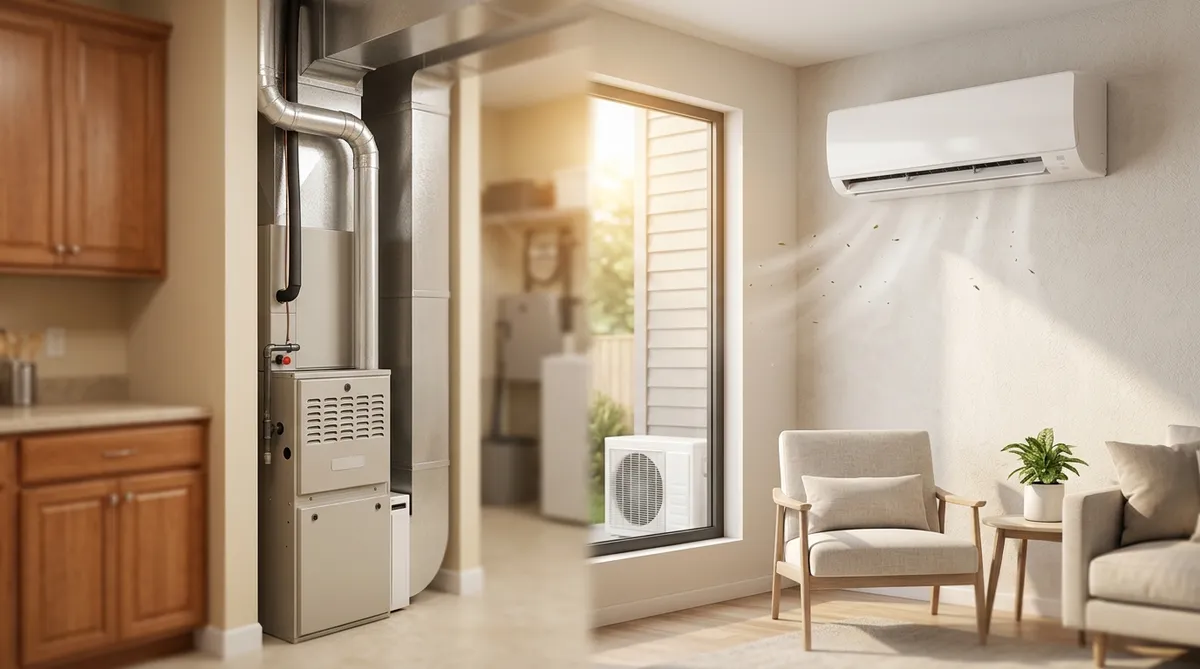
Central air systems are the backbone of cooling in many American homes. They work by pulling warm air from inside your house through a network of ducts, cooling it via a central unit (usually located outside), and then distributing the cooled air back through those same ducts to every room.
How It Works and Key Components
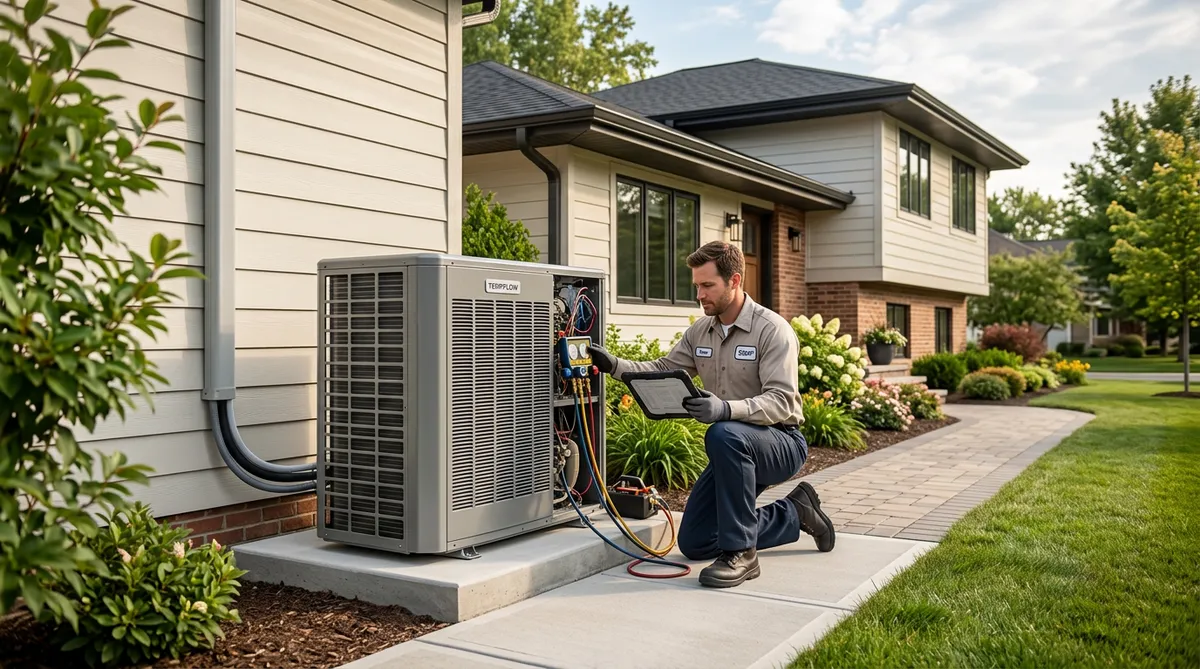
At its core, a central air system includes an outdoor condenser unit, an indoor evaporator coil (often paired with your furnace or air handler), and the ductwork that ties it all together. The refrigerant cycles through these components to absorb heat from your home and release it outside. If your home already has ductwork from a heating system, adding or upgrading to central AC is straightforward.
Pros for homeowners: It provides consistent temperatures throughout the house, making it ideal for larger spaces or open floor plans. Many systems also integrate with heating, offering year-round climate control.
However, if your ducts are leaky or poorly insulated—common in older homes—you could be losing up to 30% of your cooled air. A pro tip: Before investing, have a contractor perform a duct leakage test. Sealing or insulating ducts can boost efficiency by 20-40%, saving you hundreds on energy bills annually.
What Are Mini-Split Systems?
Mini-splits, also known as ductless mini-split heat pumps, offer a modern alternative that's especially popular in homes without existing ductwork or for additions like garages and sunrooms. Each system consists of an outdoor compressor unit connected to one or more indoor air handlers (wall-mounted units) via refrigerant lines—no ducts required.
The Basics of Operation
These systems cool (and often heat) individual zones independently. You can control each indoor unit separately, so the bedroom stays cool at night while the living room chills during the day. Multi-zone setups allow up to eight indoor units per outdoor compressor, perfect for customizing comfort room by room.
From a contractor's perspective, mini-splits shine in their simplicity. Installation involves just small holes in the wall for the lines, making them less invasive than ductwork projects. They're also incredibly efficient, often earning SEER ratings (Seasonal Energy Efficiency Ratio) of 20 or higher, compared to 14-16 for many central systems.
A practical note: If you're adding cooling to a specific space, like a home office, start with a single-zone mini-split. It's a low-commitment way to test the waters before expanding.
Cost Comparison: Upfront and Long-Term Expenses
Cost is often the deciding factor, so let's break it down realistically. Prices vary by home size, location, and system brand (think Trane or Mitsubishi for reliability), but here's what you can expect based on industry averages.
Upfront Installation Costs
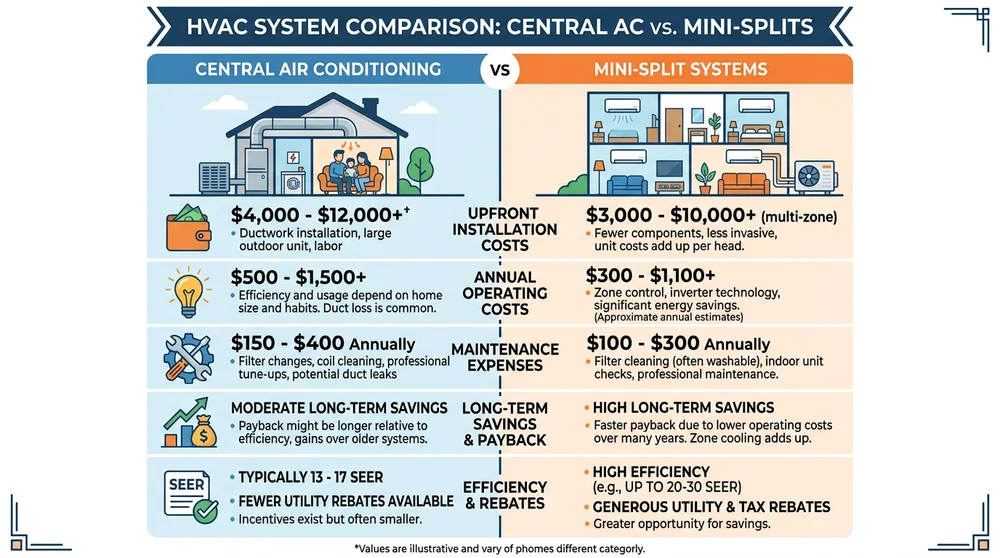
Central Air: For a full system replacement in a 2,000-square-foot home, expect $5,000 to $12,000, including the unit, labor, and any duct modifications. If your home lacks ducts, adding them can push costs to $15,000 or more. Retrofitting an existing furnace setup might keep it under $7,000.
Mini-Splits: A single-zone system for 500 square feet runs $2,000 to $5,000 installed. For whole-home coverage with a multi-zone setup (say, four zones), you're looking at $8,000 to $18,000. The beauty? You can scale gradually—no need to cool the whole house at once.
Why the difference? Central systems require more labor for duct integration, while mini-splits are modular and quicker to install (often in a day per zone).
Operating and Maintenance Costs
Energy efficiency flips the script on long-term savings. Central air might cost $500-800 per year to run in a moderate climate, but inefficient ducts inflate that. Mini-splits, with their zoning capabilities, can cut energy use by 30-50% since you're not cooling unused rooms. Annual operating costs? Often $300-600 for equivalent cooling.
Maintenance is simpler for mini-splits: Clean filters monthly and have the outdoor unit serviced yearly ($100-200). Central systems need duct cleaning every 3-5 years ($300-500) plus coil inspections to prevent mold. Over 10 years, a mini-split could save you $2,000-5,000 in total costs, especially in milder climates where zoning prevents overcooling.
Pro tip: Factor in rebates. Programs like ENERGY STAR or local utilities often offer $300-1,200 back for high-efficiency mini-splits, more than for central upgrades.
Comfort and Efficiency: Which Delivers Better Results?
Comfort isn't just about temperature—it's about even distribution, humidity control, and quiet operation.
Temperature Control and Zoning
Central air excels at uniform cooling but can struggle with hot spots if ducts are uneven. It also dehumidifies well, which is crucial in humid areas like the Southeast. However, without zoning dampers (an add-on costing $1,000+), you can't fine-tune rooms independently.
Mini-splits win on customization. Each zone has its own thermostat, so you set 72°F in the kitchen and 68°F in the bedroom. They also handle humidity effectively with inverter technology that adjusts compressor speed for steady, quiet performance (indoor units hum at 20-30 decibels, like a whisper).
Efficiency-wise, mini-splits edge out with variable-speed compressors that ramp up only as needed, reducing energy spikes. In hot climates, central might pull ahead for sheer power in large homes, but mini-splits' lack of duct losses makes them 20-40% more efficient overall.
Noise and Air Quality
Central systems can be noisy from the blower fan (50-70 decibels), and ducts can harbor dust if not maintained. Mini-splits are stealthier, with outdoor units at 50 decibels max. Many include advanced filters for better air quality, a boon for allergy sufferers.
Homeowner hack: If noise bothers you, opt for mini-splits with hyper-heat capabilities—they double as efficient heaters, eliminating the need for separate systems.
Installation Considerations and Maintenance Tips
Installation timelines and disruptions vary widely.
Central air upgrades can take 3-7 days, involving attic work or wall openings for ducts. It's best for new builds or major renovations. Ensure your electrical panel can handle the load (a 3-5 ton unit needs 20-30 amps).
Mini-splits install in 1-2 days per zone, with minimal mess—just drill 3-inch holes. They're ideal for historic homes or additions where ducts would be impractical.
For maintenance, both need annual pro checkups, but DIY is easier with mini-splits: Wipe coils and replace filters quarterly. Central systems benefit from programmable thermostats ($100-250) to optimize runtime.
When Does Each System Make Sense?
Choosing boils down to your home's layout, budget, and needs.
Go for Central Air If...
You have existing ductwork and want seamless whole-home cooling/heating integration.
Your home is over 2,000 square feet with an open layout—central handles high cooling loads efficiently.
You're in a humid climate and prioritize dehumidification over zoning.
Budget allows for upfront investment, and you plan to stay long-term (ROI in 5-10 years via equity boost).
Example: A family in Texas replacing a 20-year-old system—central air ensures even cooling for kids' rooms without multiple remotes.
Opt for Mini-Splits When...
Adding cooling to specific areas like basements, attics, or remodels without ducts.
You want zoning for energy savings in multi-story or rarely used spaces.
Installation speed and lower disruption matter (great for renters or quick fixes).
Efficiency and eco-friendliness are priorities—mini-splits use less refrigerant and power.
Scenario: A couple in California cooling a 1,500-square-foot home with uneven usage—mini-splits let them cool only occupied zones, slashing bills by 40%.
Hybrid approach? Some pros recommend mini-splits for upstairs zones paired with central downstairs—best of both worlds for $10,000-15,000.
Final Thoughts on Making Your Decision
Neither system is universally superior; it hinges on your home's specifics. Central air offers reliable, whole-home bliss for traditional setups, while mini-splits provide flexible, efficient cooling for modern, targeted needs. Consult a licensed HVAC contractor for a site assessment—they'll calculate your exact BTU requirements and run cost projections.
By weighing these factors, you'll land on a solution that keeps your home comfortable without breaking the bank. Stay cool out there!