
What Does an Electrician Charge for a Panel Upgrade? Unpacking the Costs of Going from 100 to 200 Amps
Why Consider a Panel Upgrade?
As a homeowner, you might notice flickering lights, frequent circuit breaker trips, or appliances that struggle to run simultaneously. These are classic signs that your electrical panel is outdated, especially if it's a 100-amp service common in homes built before the 1980s. Upgrading to a 200-amp panel isn't just about fixing problems—it's about future-proofing your home for modern demands like electric vehicles, home offices, and energy-efficient appliances.
From our experience at ContractorLink.pro, we've seen countless homeowners breathe new life into their electrical systems with this upgrade. It increases your home's capacity, improves safety, and can even boost resale value. But the big question on everyone's mind: what does an electrician charge for a panel upgrade? Prices can range from $2,000 to $10,000 or more, and understanding why they vary is key to avoiding surprises.
Understanding the Basics of a 100-Amp to 200-Amp Upgrade
A electrical panel, or breaker box, is the heart of your home's electrical system. It distributes power from your utility service to your circuits. A 100-amp panel handles about 12,000 watts of power, which was sufficient for mid-20th-century homes with basic lighting and a few outlets. Today, with air conditioners, microwaves, and smart devices, that capacity often falls short.
Switching to a 200-amp panel doubles your service capacity to 24,000 watts, allowing for more circuits and heavier loads. The upgrade typically involves replacing the main panel, updating the meter base if needed, and possibly running new wiring from the utility connection. Licensed electricians handle this because it involves high-voltage work and must comply with the National Electrical Code (NEC) and local regulations.
Why the jump to 200 amps specifically? It's the standard for most modern homes and strikes a balance between cost and capacity. Larger upgrades, like 400 amps, are overkill for typical residences and drive up expenses unnecessarily.
Factors That Drive the Cost of a Panel Upgrade
The price variation in panel upgrades stems from several interconnected factors. No two homes are alike, so what costs $3,000 in one scenario might balloon to $8,000 in another. Let's break it down.
Location and Local Regulations
Where you live plays a huge role. In urban areas like New York or San Francisco, labor rates are higher—electricians might charge $100 to $150 per hour compared to $75 to $100 in rural Midwest spots. Permits are another wildcard: expect $200 to $500 for inspections and approvals, but in strict jurisdictions, fees can exceed $1,000.
Utility involvement adds complexity. Some providers require their own upgrades to the service drop (the line from the pole to your house), which could be free or cost thousands if your current setup doesn't meet standards. We've connected homeowners with pros who navigate these local quirks seamlessly.
Home Accessibility and Age
Is your panel in a basement, garage, or attic? Easy access keeps costs down, but if it's behind drywall, in a crawlspace, or near asbestos-laden materials (common in older homes), demolition and remediation jack up the bill. For a 1950s house, you might need to address knob-and-tube wiring, adding $1,000 to $3,000 for partial rewiring.
Panel age matters too. If your 100-amp setup is aluminum-wired (pre-1970s), safety upgrades like AFCI breakers or grounding become mandatory, inflating costs by 20-30%.
Scope of the Project
A basic upgrade swaps the panel and meter for $2,500 to $4,000. But if you want to add subpanels for a garage EV charger or expand circuits for a kitchen remodel, you're looking at $5,000+. Including surge protection, smart breakers, or generator interlocks? That pushes it toward $7,000.
Utility entrance cable upgrades are often required for 200-amp service. Replacing the old 100-amp wire with thicker 2/0 copper or aluminum can cost $500 to $2,000, depending on length and trenching needs.
Material and Labor Choices
Panels themselves range from $500 for a basic 200-amp model to $1,500 for premium brands like Square D or Siemens with advanced features. Breakers, conduits, and grounding rods add another $300 to $800.
Labor is 50-70% of the total. A straightforward job takes 8-12 hours for one or two electricians, but complex ones stretch to days. Hourly rates vary, but expect $1,500 to $4,000 in labor alone. Hiring a master electrician versus a journeyman affects pricing—go for licensed pros to ensure code compliance and warranties.
Average Costs Breakdown: What to Expect
Based on national averages from sources like HomeAdvisor and our network of contractors, here's a realistic cost breakdown for a 100-amp to 200-amp upgrade:
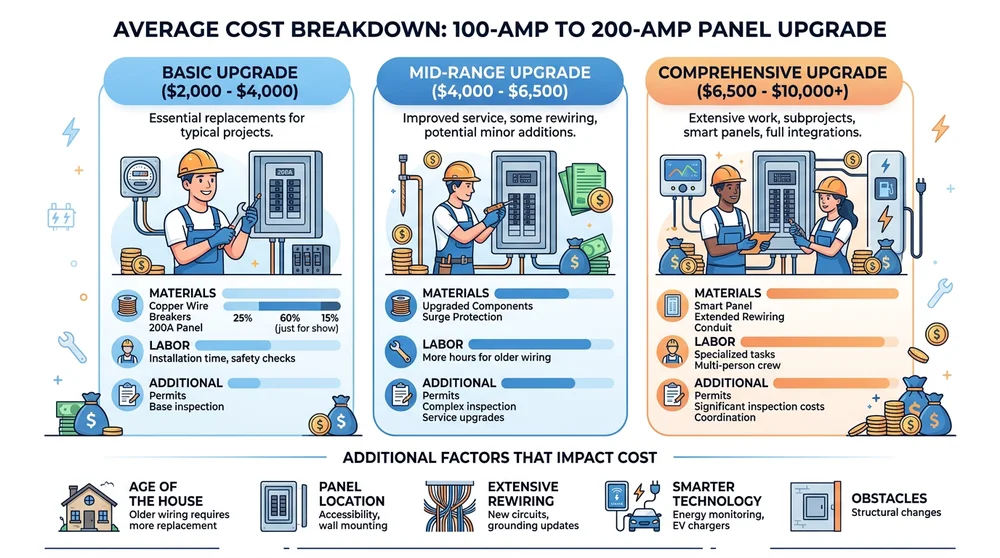
Basic Upgrade (Panel and Meter Swap): $2,000 - $4,000
- Includes new 200-amp panel, breakers, and basic installation.
- Ideal for accessible locations in newer homes.
Mid-Range Project (With Wiring Updates): $4,000 - $6,500
- Adds service entrance cable replacement and minor circuit expansions.
- Common for homes 30-50 years old.
Comprehensive Upgrade (Full Rewiring Elements): $6,500 - $10,000+
- Involves accessibility challenges, permits, utility work, and safety add-ons.
- Necessary for older homes or those with multiple electrical issues.
These figures include materials and labor but exclude surprises like unforeseen code violations. In high-cost areas, add 20-50%. Always get multiple quotes—our platform makes it easy to compare licensed electricians in your zip code.
Regional variations are stark: In the South, you might pay $2,500 on the low end, while Northeast projects average $5,000 due to union labor and weatherproofing requirements.
Hidden Costs and How to Avoid Them
Beyond the basics, watch for these sneaky expenses:
- Utility Fees: Connection upgrades or temporary power shutoffs can add $500+.
- Drywall Repair: Opening walls for access? $300 to $1,000 to patch up.
- Temporary Power Solutions: If your whole home loses power during work, generators rent for $200/day.
- Code Upgrades: Modern NEC requires GFCI outlets in wet areas—budget $500 if not already compliant.
To minimize costs, schedule during off-peak seasons (avoid summer AC strain). Opt for energy-efficient components to qualify for rebates—some utilities offer $200-500 incentives for 200-amp upgrades.
Pro tip: Conduct a load calculation before upgrading. An electrician can assess your current usage (via a $100-200 audit) to confirm 200 amps is right, preventing overpaying for unnecessary capacity.
DIY vs. Professional: Why Hire an Electrician?
We get it—saving money tempts some to DIY. But panel upgrades are not beginner territory. High-voltage risks include electrocution, fires, or voiding insurance. Plus, improper work fails inspections, leading to rework costs.
Hiring a pro ensures safety, compliance, and a 1-5 year warranty. Look for electricians with EC&M or NEC certifications. At ContractorLink.pro, we vet pros for reliability, so you get quotes from trusted experts.
Is a Panel Upgrade Worth the Investment?
Absolutely, if your home's electrical system is strained. Beyond reliability, it supports expansions like additions or solar panels. ROI? Expect 50-70% recouped on resale, per Remodeling Magazine's Cost vs. Value report.
In summary, electrician charges for a 100-to-200-amp panel upgrade hinge on location, home specifics, and project scope—ranging widely but averaging $3,500-$6,000. By understanding these drivers, you can plan smartly and enhance your home's electrical backbone safely.
(Word count: 1,248)